
On the same Amazon product, CrawlGecko returned the most reviews (881), about 3× BrightData (303), Chat4Data (98) and Outscraper (12). BrightData is the cheapest per 1,000 records ($1.50) and was the fastest. Choose CrawlGecko for review depth and a dashboard, BrightData for enterprise and developer APIs. The full method and data are below.
We all know Amazon reviews scraping is the ultimate cheat code to winning the ecommerce game. In fact, with the global AI boom, this data has become so valuable that Amazon spends millions of dollars just fighting scrapers.
By August 2026, benchmarks showed that the difficulty of scraping Amazon moved from moderately difficult to very hard. And this made DIY and low-cost in-house scrapers impractical at scale due to sheer maintenance costs, ranging from weeks of manual labour for developers and up to $400k for enterprises.
And that's where dedicated tools come in. The best review scrapers handle Amazon's advanced anti-bot defenses, aggressive IP banning & CAPTCHAs, and constant DOM changes. You simply provide the ASIN.
However, with the flood of low-grade scrapers on Apify, we had to hand-compile all the best Amazon review scrapers in 2026, test them, compare, and rank each by quality. See the top five below.
The 5 Best Amazon Review Scrapers in October 2026

CrawlGecko
Crawlgecko.com is special because it’s the only tool that graduated from a simple scraper to a full-blown Amazon review intelligence tool.
CG not only solves bulk scraping and exporting for data companies and AI workflows, but also provides a clean dashboard for brand managers, agencies, and stores to continuously track sentiment over time.
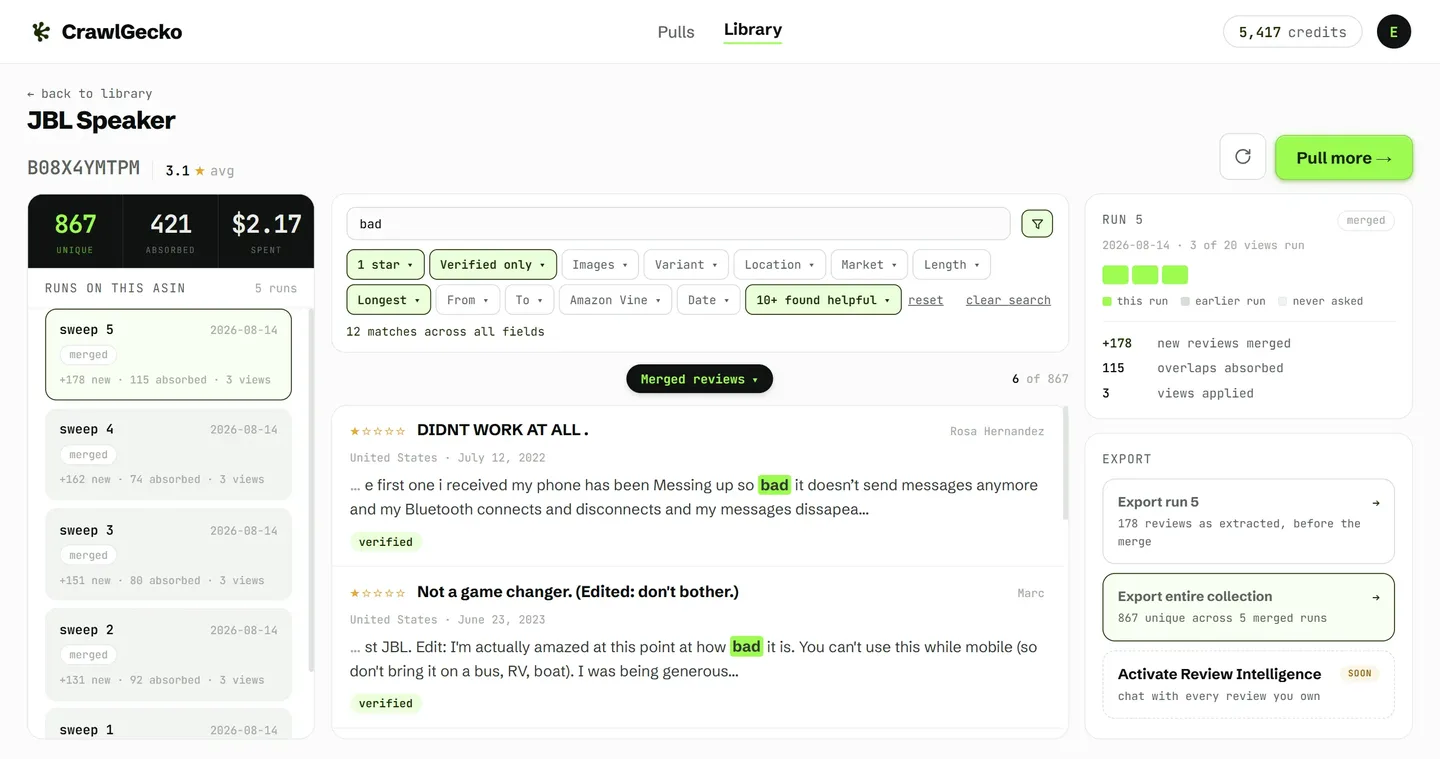
Each ASIN/Product automatically gets its own library, with a “pull more” button that lets you add new reviews to the same ASIN. And you are billed for only new reviews, so dedups stay free forever.
There you can use the search bar and custom filter to track sentiment by:
- →Keyword (ex. bad, broken lid, etc.)
- →Variant
- →Star rating, date and location
- →Verified Purchase and badges
- →And sort by longest or most helpful
What’s more, when you filter your reviews, you can also export just the filtered set for targeted analysis. And if the depth is overwhelming (CrawlGecko fetches 500-1000+ reviews per ASIN), you can easily bulk export all your libraries to feed your data pipelines or artificial intelligence models.
Additionally, CrawlGecko’s proprietary “AI in the middle (AITM)” review scraping is self-healing and structurally immune to layout drift, which drops maintenance costs and directly makes it affordable.
- ✓500-1k reviews per ASIN (library keeps growing)
- ✓AI-powered self-healing engine (no maintenance required)
- ✓Auto-dedups, even on new runs
- ✓Simple user dashboard with a full set of filters for brand managers, agencies, or competitor tracking
- ✓99% success rate on Amazon
- ✓Pricing from $1.70 per 1000 reviews
- ✕Amazon scraper API for enterprises only
- ✕Export to CSV and JSON only

BrightData
BrightData is an enterprise-grade tool with an Amazon review scraping module. The provider excels in uptime and extraction success thanks to its large proxy infrastructure.
It’s also tailored for developers who know their way around scraper configuration, which makes it flexible. Although setup can be tedious for non-technical users.
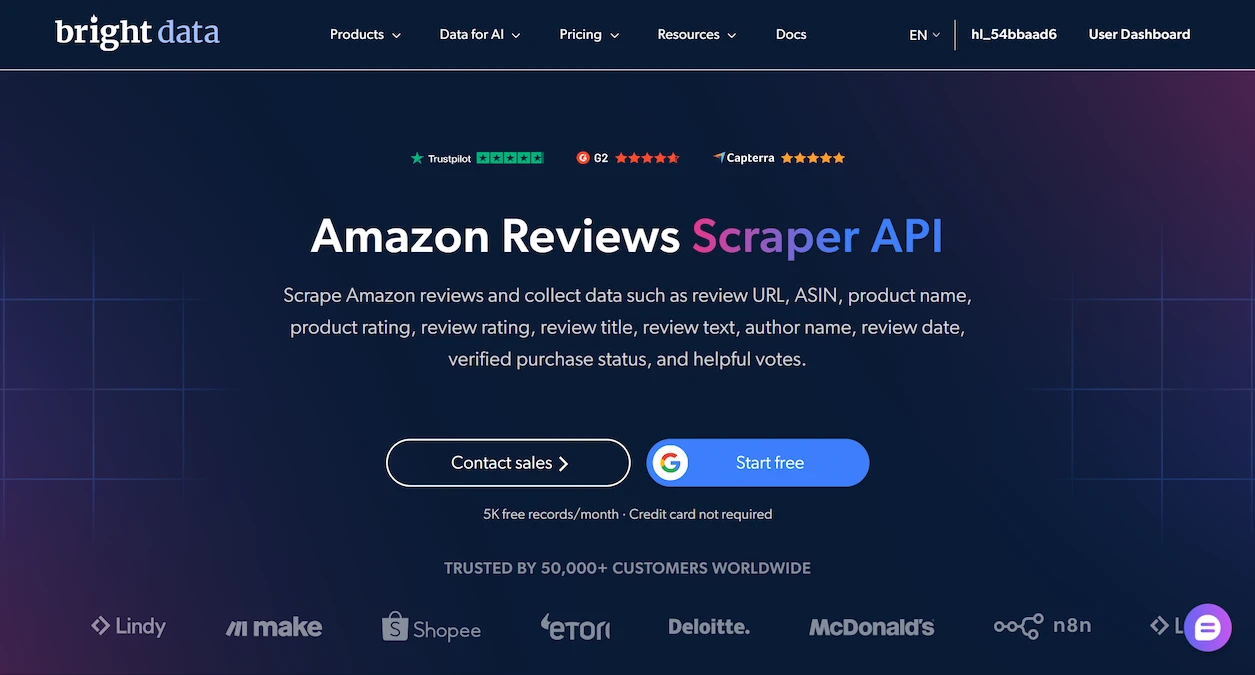
In terms of extraction quality, it matches CrawlGecko’s 11 fields, while providing more metadata, such as reviewer URL and total review count. In addition, BrightData provides much more scraping services, including price and product page data extraction, offering more than just sentiment analysis.
However, depth was on the lower side. Most ASINs scraped with BrightData provide about 40-300 reviews per ASIN. And while highly reliable, configured scrapers are prone to layout drift and maintenance costs unlike CrawlGecko.
- ✓$1.50 for 1,000 reviews
- ✓All-in-one scraping services
- ✓High success rate on Amazon
- ✓Amazon Scraper API provided
- ✕Low review count (~40 reviews per ASIN)
- ✕Requires some technical ability
- ✕Users cannot scrape by star ratings
- ✕Plan starts at $499/month (Bulk) or pay-as-you-go

Apify & Chrome Store
Apify is a subscription-based platform with thousands of specialized scrapers for different jobs.
On this platform, over two dozen Amazon review scrapers known as “actors” exist, all by different developers. Meanwhile, Chrome Store is also home to dozens of scrapers that can run live in your browser while you navigate.
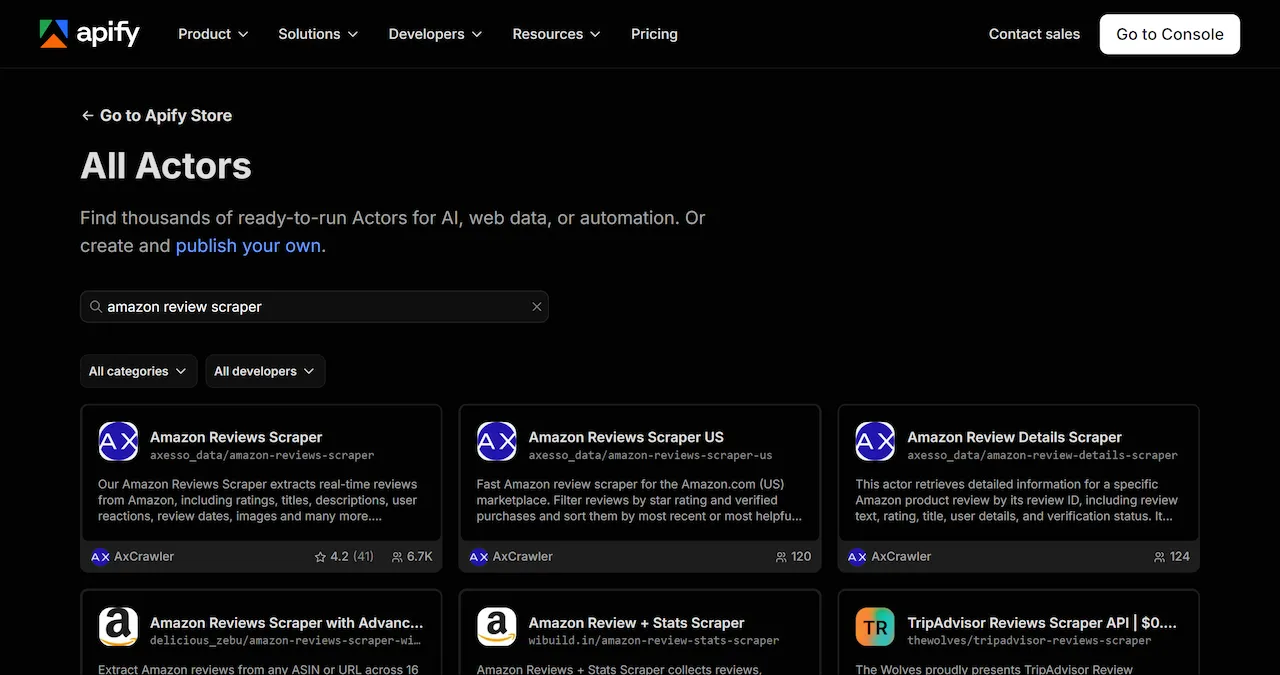
And as you can expect with marketplaces, quality ranges widely from good to bad. In truth, the average rating of Amazon review scrapers on Apify and Chrome Store is relatively mid to low, as most are low-budget developer tools that aren’t built for scale.
Still, there were standout options like the tools from Axesso Data, which is currently the top Amazon review scraper Apify has to offer. Along with the Chrome Store, these marketplaces keep the costs competitive, which is good news for price-sensitive customers.
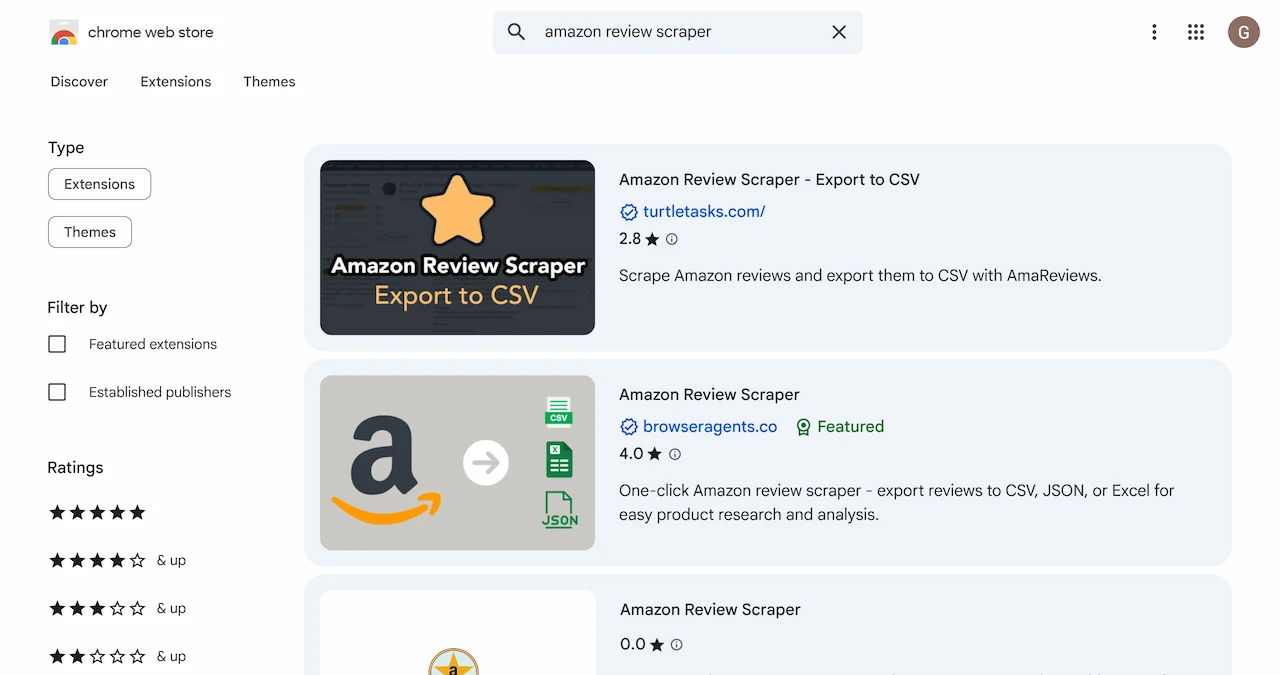
However, reliability and customer support can be an issue with small developer tools. As a rule of thumb, try an Apify or Amazon review scraper extension with many users and many ratings, with a good average. You may just have to subscribe first.
- ✓Native API integrations with Apify make data integration easy
- ✓Competitive market, good for price and quality
- ✓Simple-to-use Chrome extensions
- ✕Maintenance burden: most actors and extensions are run by single developers, so bug fixes and customer support are notoriously poor
- ✕Developer-first platform: Apify users must handle configuration and setup, requiring strong technical knowledge

Chat4Data
Chat4Data is a rather interesting tool on this list. By shifting the scraping work from Python code to artificial intelligence, specifically LLMs, they successfully tackled the layout drift problem.
Instead of fragile selectors, Chat4Data uses trained AI models to read the page and extract the reviews. This makes it significantly robust, as the lack of breaking selectors reduces the maintenance costs.
However, the trade-off is pure cost. AI scrapers parse entire pages, easily burning through tens of thousands of tokens on a single page. And if not properly guarded, LLMs can consistently hallucinate letters or words, like mistaking a small letter l (L) for a capital letter I (i).
Ironically, that unreliability, if high, can make LLM scrapers impractical for AI data pipelines that swallow millions of reviews. In addition to being non-deterministic, LLM scrapers can be notably slow because they must first read the page and then print out what they see.
Another specific weakness of Chat4Data is that you must be in the window where the tool is actively scraping, making it very hands-on.
- ✓LLM scraping makes Chat4Data resilient to layout changes
- ✓Friendly starter pricing: starts at $10 a month, with max plan at $30
- ✕LLM scrapers have high and inconsistent token usage
- ✕AI scrapers often fall victim to hallucination and data corruption
- ✕Users must be active while Chat4Data is running

Outscraper
Although dozens of other competent Amazon review scraping tools still exist, it’s Outscraper that closes out the list at number 5.
Outscraper is a specialized tool, offering at least 20 different scraping services. And one of them is an Amazon review scraper, alongside a full product scraper. That combo makes this tool a good option if you want to pull both the products and their data from the same place.
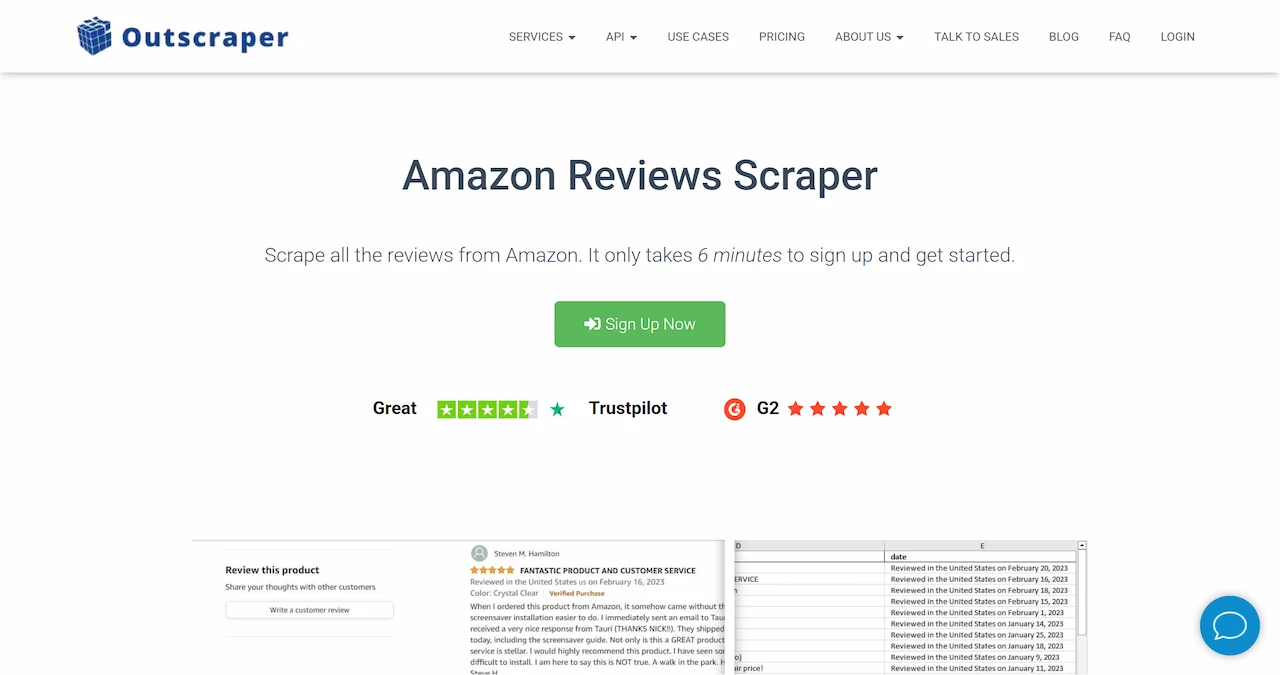
And pricing-wise, the provider is moderately cheap at $2.00 for 1,000 reviews. But depth-wise, Outscraper is lacking, with 12 reviews max per Amazon ASIN/product.
This makes it a weaker Amazon review scraping tool on its own. But paired with the general product scraper, Outscraper does allow for broader analysis compared to CrawlGecko.
- ✓Also does general Amazon product scraping
- ✓Pricing is affordable at $2 per 1k reviews
- ✓Comes with 20+ scraping services
- ✕Only 12 reviews per ASIN max
- ✕You pay for duplicate records
Amazon review scraper tools compared
Pick the best in 2026 by what you actually need: depth, price, or reliability.
| TOOL | REVIEWS / ASIN | PRICE | SUCCESS | BEST FOR |
|---|---|---|---|---|
| CrawlGecko | 500–1,000+ | From $1.70 / 1k | 99% | Brands & agencies |
| BrightData | ~40–300 | $1.50 / 1k | 95–98% | Enterprise & developers |
| Apify & Chrome Store | 10–100 | $0.90–$15 / 1k | 20–90% | Price shoppers |
| Chat4Data | ~98 | $10–$30 / month | Up to 99% | Simplicity |
| Outscraper | 12 max | $2.00 / 1k | 91–95.3% | General product research |
What is an Amazon review scraper?
An Amazon review scraper is a tool that collects customer reviews from Amazon product pages and returns them as structured data. You give it an ASIN, Amazon’s product ID, and it returns fields such as the review text, star rating, title, date, reviewer name and location, product variant, verified-purchase flag and helpful votes, usually as a CSV or JSON file.
Copying reviews by hand doesn’t scale, and Amazon works to block automated access. So the tools differ less in what they can extract than in how many reviews they actually return, and how reliably they keep working.
Why scrape Amazon reviews?
Reviews are the largest body of unfiltered customer feedback on any product, and they directly move sales. Northwestern’s Spiegel Research Center found that a product with five reviews is 270% more likely to be purchased than one with none, and that the effect is stronger on higher-priced items. Reading a few reviews by hand tells you little. Collecting them all tells you a lot. Here is what teams do with the full set.
Track sentiment over time
A single average rating hides what is happening underneath. With every review in a table, you can filter by keyword, variant, star rating, date or location and see which complaints are growing, which features customers praise, and whether a recent product change helped or hurt. Because each review is dated, a drop from 4.4 to 3.9 over two months shows up as a trend you can act on, not a surprise.
Research competitors without guessing
A rival’s reviews are free market research that tells you what their buyers wanted and did not get. Reading every review, instead of the first page of “top” reviews, shows you the gaps in their product, the questions customers keep asking, and the language shoppers use to describe the problem you both solve. Brands use it to position a new listing, and agencies use it to brief clients.
Improve products and listings
Repeated complaints are a prioritized fix list. If forty reviews mention a lid that cracks, that is a manufacturing issue worth escalating, and if a hundred reviews ask whether a product fits a specific model, that answer belongs in your listing. Star ratings also split by variant, so you can spot a single size or color that drags the whole product down.
Check review quality and authenticity
Raw review data lets you measure what the star average cannot: the share of verified purchases, reviews with photos, Amazon Vine reviews, how reviews cluster by date, and how ratings differ between verified and unverified buyers. A sudden burst of five-star reviews on one day, or a rating mix that is unusually uniform, is worth a closer look before you rely on a competitor’s numbers or your own.
Feed data pipelines and AI models
Review text is labeled, opinionated and plentiful, which makes it useful for sentiment classifiers, topic modeling, search, and training or evaluating language models. That needs depth and clean structure: a few hundred records per product, consistent fields, and a CSV or JSON export that loads without cleanup. This is where scrapers that return 12 reviews and scrapers that return 800 stop being comparable.
See how brands and agencies use review data on our Solutions page.
How to scrape Amazon reviews: DIY or a tool
There are two routes, and the right one depends on volume.
Build it yourself. Write a scraper in Python using a browser-automation library such as Playwright or Selenium, add rotating residential proxies, manage browser fingerprints, and update your parsing code each time Amazon changes its layout. Plain HTTP requests are usually blocked. This is fine for a small one-off job and gets expensive to maintain at scale.
Use a dedicated tool. Give the scraper an ASIN and get a file back. With CrawlGecko the steps are:
- →Enter the product’s ASIN.
- →Choose how many reviews to pull.
- →Inspect the reviews and accept them. You pay only for what you keep, and discards are free.
- →Export the result as CSV or JSON.
Every new account can scrape 100 reviews free, no credit card needed, so you can try it on your own ASIN.
What makes a great Amazon review scraper?
Most comparisons stop at price. A scraper that is cheap per record but returns a fraction of the reviews, or breaks every few weeks, is not cheap. Guides to choosing a scraping provider, such as Zyte’s framework for evaluating a web scraping company, point to the same themes: reliability, who maintains the scraper, compliance and delivery. We turned those into the criteria below, and the first four are the ones we measured in the benchmark.
Data depth
The first question is how many unique reviews you actually get for one ASIN. Amazon limits what a logged-out visitor can see, and some tools stop at the first page or a fixed cap, which is how a sample of 12 and a sample of 881 can come from the same product. Depth decides whether your sentiment filters, trend lines and training sets are meaningful. Check whether the tool deduplicates across runs too, so a second pull adds new reviews instead of repeats you pay for again.
Cost
Compare on a like-for-like unit, such as price per 1,000 reviews, and then adjust for what you really receive. A tool that charges for duplicates or failed requests costs more than its list price. Subscription tools like Chat4Data and Apify marketplace actors are harder to compare, since the monthly fee only pays off at volume. Look for a way to inspect results before paying.
Extraction time
Speed matters most when you run many ASINs or refresh libraries often. But read it next to depth: a tool that finishes in six minutes with 303 reviews is not directly comparable to one that takes eleven minutes and returns 881. Time per review is a fairer figure than total time.
User experience
Some tools are built for developers, with configuration, API keys and scripts, and others for analysts and brand managers, with a dashboard, filters and exports. Neither is wrong, but the wrong fit costs hours. If the people who need the reviews cannot run the tool themselves, the data will wait on an engineer.
Reliability and maintenance
Amazon changes its pages and its anti-bot defenses often, so ask who fixes the scraper when it breaks and how the vendor reports success rate. Selector-based scrapers need repairs after layout changes. Marketplace tools run by a single developer can go quiet. A vendor that owns maintenance, with a stated success rate, is worth a premium over one that leaves it to you.
Data quality, compliance and export
Finally, check that the output is clean and complete, with fields such as rating, date, variant, verified-purchase flag and helpful votes, and that it exports to CSV or JSON without conversion. Collect only public review data, avoid personal data you do not need, and review the vendor’s terms and any rules that apply to your use. Our answer on legality is in the FAQ below. The next section shows how each tool did against these criteria.
Amazon Reviews Scraper Benchmark
Only performance can truly rank these tools, which is why we scraped the Amazon reviews for ASIN B0DVJ64MKD with each of them. We measured four things: data depth, cost, extraction time and user experience.
CrawlGecko is shown at its Starter pack ($2.50 per 1,000); Growth is $2.00 and Scale is $1.70 (see pricing). Apify and Chrome Store tools are left out: they're dozens of small developer tools averaging $3–9 per 1k for reliable options, and Apify needs a subscription first.
BrightData was quickest, but returned about a third of CrawlGecko's dataset. Weigh speed against depth.
- 1CrawlGecko. Only Amazon review scraper with a user dashboard and collections for visual analysis and competitor tracking.
- 2Chat4Data. The next best for experience, with a simple ChatGPT-style interface.
- 3Outscraper. Another really simple option: locate the review scraper, enter the ASIN and any extra settings.
- 4BrightData. A developer-first tool, so the experience is unintentionally challenging for non-technical users.
- 5Apify & Chrome Web Store. Each actor and extension is managed by an independent developer, so users must configure each separately.
How we tested
Every tool got the same input: ASIN B0DVJ64MKD, a 1 oz nail-care cream with reviews dating from March 2015 to October 2026. We ran the test in October 2026. This is how we measured each result:
- →Data depth: unique reviews the tool returned for the ASIN.
- →Cost: each vendor’s published price per 1,000 records. Chat4Data bills monthly, so its entry plan is shown instead. CrawlGecko is shown at its Starter pack.
- →Extraction time: how long the tool took to deliver its results, shown next to the reviews it returned.
- →User experience: our ranking of how easy each tool is to set up and use.
Important: We make CrawlGecko, so we publish our full output below so you can verify our side. The counts for the other tools are what each returned on this one ASIN in October 2026. Results vary by product and over time, and a single product is a small sample. If you run any of these tools on the same ASIN and get a different result, tell us at our contact page.
What’s in the dataset
| Product | ASIN B0DVJ64MKD, a 1 oz nail-care cream (Coconut variant) |
|---|---|
| Records | 881 unique reviews, 13 fields each |
| Review dates | March 25, 2015 to October 13, 2026 |
| Star ratings | 5★ 202 · 4★ 181 · 3★ 137 · 2★ 149 · 1★ 212 (average 3.0) |
| Verified purchases | 858 of 881 |
| With images | 327 |
| Amazon Vine | 6 |
| Reviewer location | 871 United States, 10 other |
| Collected | October 16, 2026 (by CrawlGecko) |
| Formats | CSV · JSON |
Cite this benchmark
Using these numbers in your own work? Please link back to this page.
Summary
On this exact benchmark, CrawlGecko is the best Amazon review scraper in October 2026, followed by BrightData, Apify, Chat4Data, and Outscraper.
Frequently Asked Questions
Yes, and for many years, that’s how people mostly did it, with low-cost custom-built scrapers. But Amazon has now made it very impractical to do so in 2026. Notably, Amazon is one of the most hostile sites to web scrapers, banning IPs shortly after starting. You must now get and manage residential proxies, implement browser fingerprints, and fight enterprise anti-bot defenses, all while solving layout drift. It’s possible, but impractical for non-commercial developers.